Pioneering
Creative
Excellence
ardenatech.com
Pattern Interruption: The Visual Science of the 'Stop-Motion' Scroll
Learn the visual psychology behind scroll-stopping content -- why certain images and videos freeze the thumb mid-scroll and how to engineer that effect for your brand.

Every second, millions of thumbs are in motion -- flicking through feeds at a pace that makes traditional advertising theory look quaint. The average social media user scrolls through roughly 90 metres of content per day, a distance that would stretch the length of the Statue of Liberty laid on its side. In that relentless river of images, videos, and text, your content has approximately 1.3 seconds to justify its existence before the thumb carries on.
This is not a branding problem. It is a physics problem -- or more precisely, a neuroscience one. The question is not whether your content is good. The question is whether it can interrupt a deeply ingrained motor pattern quickly enough to register in a brain that has learned to filter almost everything out.
Welcome to the science of pattern interruption, and it is more systematic than you might think.
The Neuroscience of the Scroll
To understand why some content stops the scroll while most does not, you need to understand what the brain is doing during a feed session. Scrolling is a semi-automatic behaviour -- similar to driving a familiar route. The brain enters a low-attention processing mode where it scans for novelty while filtering out the expected. Neuroscientists call this habituation: the brain's tendency to ignore stimuli that match established patterns.
Your feed is full of patterns. Smiling faces with text overlays. Product flat-lays on white backgrounds. Talking heads with subtitles. These formats are not bad, but they are expected. The habituated brain processes them as background noise and the thumb keeps moving.
Pattern interruption occurs when a visual stimulus violates the brain's prediction model. Something appears that does not fit the established pattern of the feed, and the brain's attention system -- specifically the anterior cingulate cortex -- fires an alert. The thumb pauses. The eyes focus. You have earned your 1.3 seconds, and now you have a chance to earn the next thirty.

The Five Triggers of Visual Pattern Interruption
1. Chromatic Contrast
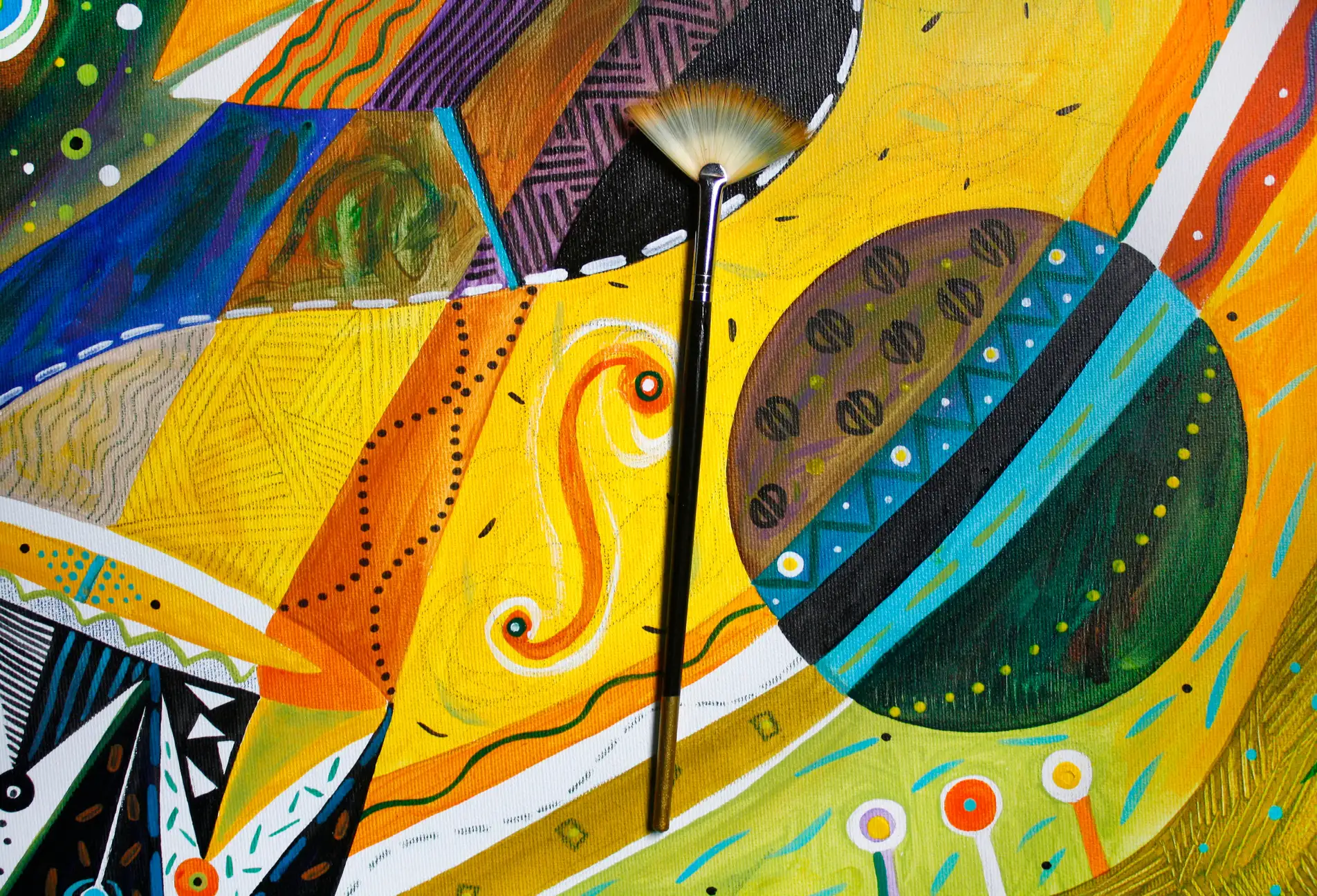
Chromatic contrast is the most reliable scroll-stopper because it operates at the pre-attentive processing level -- the brain registers colour anomalies before conscious awareness kicks in. If the feed is dominated by warm tones, cool tones stand out. If most content uses muted palettes, saturated colour draws the eye.
The practical application is straightforward but requires discipline. Before designing creative, screenshot the feed environment where your content will appear. Study the dominant colour patterns. Then design your visuals to contrast with that environment, not to match your brand guidelines in isolation. Your brand colours matter, but they matter more when they create contrast against the feed's visual baseline.
2. Spatial Disruption
Spatial disruption breaks the expected composition patterns of the feed. Most social content follows predictable layouts: centred subjects, rule-of-thirds composition, standard aspect ratios. Content that uses unusual cropping, extreme close-ups, unexpected negative space, or deliberately off-centre framing triggers spatial novelty detection.
A macro shot of a texture, a dramatically tilted horizon, or a composition where the subject is barely visible in the corner of the frame -- these are not conventional "good photography" choices. But they are effective pattern interrupts because they force the brain to work harder to interpret the image, which requires focused attention.
3. Motion Anomaly
Motion anomaly is particularly powerful in video-dominant feeds. When every video in the feed features smooth, standard-speed footage, content that opens with a freeze frame, a sudden speed ramp, stop-motion animation, or reverse playback creates a motion pattern that the brain flags as unusual.
This is where the "stop-motion scroll" gets its name. The technique of using actual stop-motion or stop-motion-style editing -- jerky, frame-skipping, visually staccato movement -- creates a motion signature that is fundamentally different from the smooth video the brain has learned to scroll past. It is a visual stutter in a world of seamless motion, and it demands attention.
4. Cognitive Incongruity
Cognitive incongruity places two elements together that the brain does not expect to see in combination. A business executive in a swimming pool. A luxury product in a gritty industrial setting. A data visualisation made from food. The brain's prediction model says these elements do not belong together, and resolving the incongruity requires attention.
This trigger is the most creatively demanding but also the most shareable. Content that creates cognitive incongruity does not just stop the scroll -- it generates the kind of curiosity that drives comments, shares, and saves. As we explored in engineering the first hour of viral velocity, that initial burst of engagement is what signals to the algorithm that your content deserves wider distribution.
5. Text Pattern Breaking
Text pattern breaking applies to the typographic elements of your content. Most social text uses standard platform fonts at standard sizes. Content that integrates bold, oversized, hand-drawn, or animated typography creates a visual element that stands apart from the text-heavy sameness of the feed.
A single word in dramatically large type, a hand-written annotation over a photograph, or kinetic typography that moves differently from standard subtitle animations -- these create text-based pattern interrupts that work even when the image beneath is conventional.
From Theory to Creative Strategy
Understanding the triggers is the first step. Building a repeatable creative strategy around them is where the real value lies.
Audit Your Feed Environment Monthly
The feed is not static. Visual trends shift constantly, which means what counts as a pattern interrupt changes too. A bright yellow background might be disruptive today and cliche in three months. Schedule monthly audits of the primary feeds where your content appears. Document the dominant visual patterns and adjust your creative to stay ahead of habituation.
Build a Pattern Interrupt Library
Create an internal reference library of content -- your own and others' -- that successfully stops the scroll. Categorise each example by which of the five triggers it employs. When briefing designers and videographers, reference specific examples from the library rather than relying on abstract descriptions. This makes the concept tangible and repeatable.
Layer Multiple Triggers
The most effective scroll-stopping content combines two or three triggers simultaneously. A video that opens with a motion anomaly, uses chromatic contrast, and features cognitive incongruity is almost impossible to scroll past. The layering effect creates a multi-signal alert that overwhelms the brain's habituation filters.
However, restraint matters. Combining all five triggers at maximum intensity creates visual chaos, not effective communication. Choose two or three triggers that align with your brand identity and message, and execute them with precision.
Measure the Right Metrics
Scroll-stopping success is not measured by reach alone. The metrics that matter are:
- Thumb-stop rate -- The percentage of impressions that convert to views of at least two seconds. This is the direct measure of pattern interruption effectiveness.
- Hold rate -- The percentage of people who stop and continue watching or reading beyond the initial pause. A high thumb-stop rate with a low hold rate means your interrupt works but your content does not deliver on the promise.
- Bounce reduction -- Track how pattern interruption creative affects overall page and profile bounce rates compared to standard creative.
Getting these metrics right also depends on your broader digital presence. A compelling social creative that drives traffic to a poorly designed website wastes the attention you worked so hard to earn. Ensuring your web experience is responsive and polished is the other half of the equation.
The Balance Between Disruption and Brand
There is a tension inherent in pattern interruption. By definition, it asks you to deviate from what is expected. But brand consistency asks you to be recognisable. The resolution lies in developing a signature disruption style -- a consistent way of being inconsistent.
Some brands own a specific colour that always contrasts with feed environments. Others develop a recognisable editing style that uses motion anomaly as a trademark. The best approaches make pattern interruption part of the brand identity itself, so that the disruption becomes the recognition.
This is where working with a team that understands both brand identity and social media strategy becomes essential. The creative needs to interrupt the pattern and reinforce the brand simultaneously -- and that requires a unified strategic vision.
Make Your Content Impossible to Scroll Past
The feed will only get faster. Attention spans will only get shorter. The brands that thrive are the ones that treat scroll-stopping not as a happy accident but as an engineered outcome. If you are ready to build a creative strategy rooted in visual psychology and tested against real engagement data, let us talk. We will help you design content that earns the pause -- and everything that follows it.